Where Should a Next.js App Run? Vercel vs Coolify on a VPS
Next.js is an open-source React framework for building websites and web applications. It can render pages, run server-side code, and coordinate data access in one project. A finished project still needs a production home: internet-connected infrastructure that keeps the application available after the developer’s laptop is closed.
Vercel and Coolify are often presented as two versions of that home, but they are different kinds of product. Vercel is a managed hosting platform that builds and runs the repository on its own infrastructure. Coolify is open-source deployment software installed on a Linux server you provide. That server is often a VPS: a rented virtual machine with a defined amount of CPU, memory, storage, and network capacity.
The real comparison is therefore Vercel versus a VPS operated through Coolify. One hides much of the server operation inside a metered platform; the other makes deployment easier while leaving the machine in your hands. The consequential differences appear after the deploy succeeds: updates, capacity, billing, backups, and recovery.
Two models, two different boundaries
Choose Vercel when removing host operations is worth a metered platform bill. Choose Coolify on a VPS when you are prepared to own the server and prefer a defined capacity envelope.
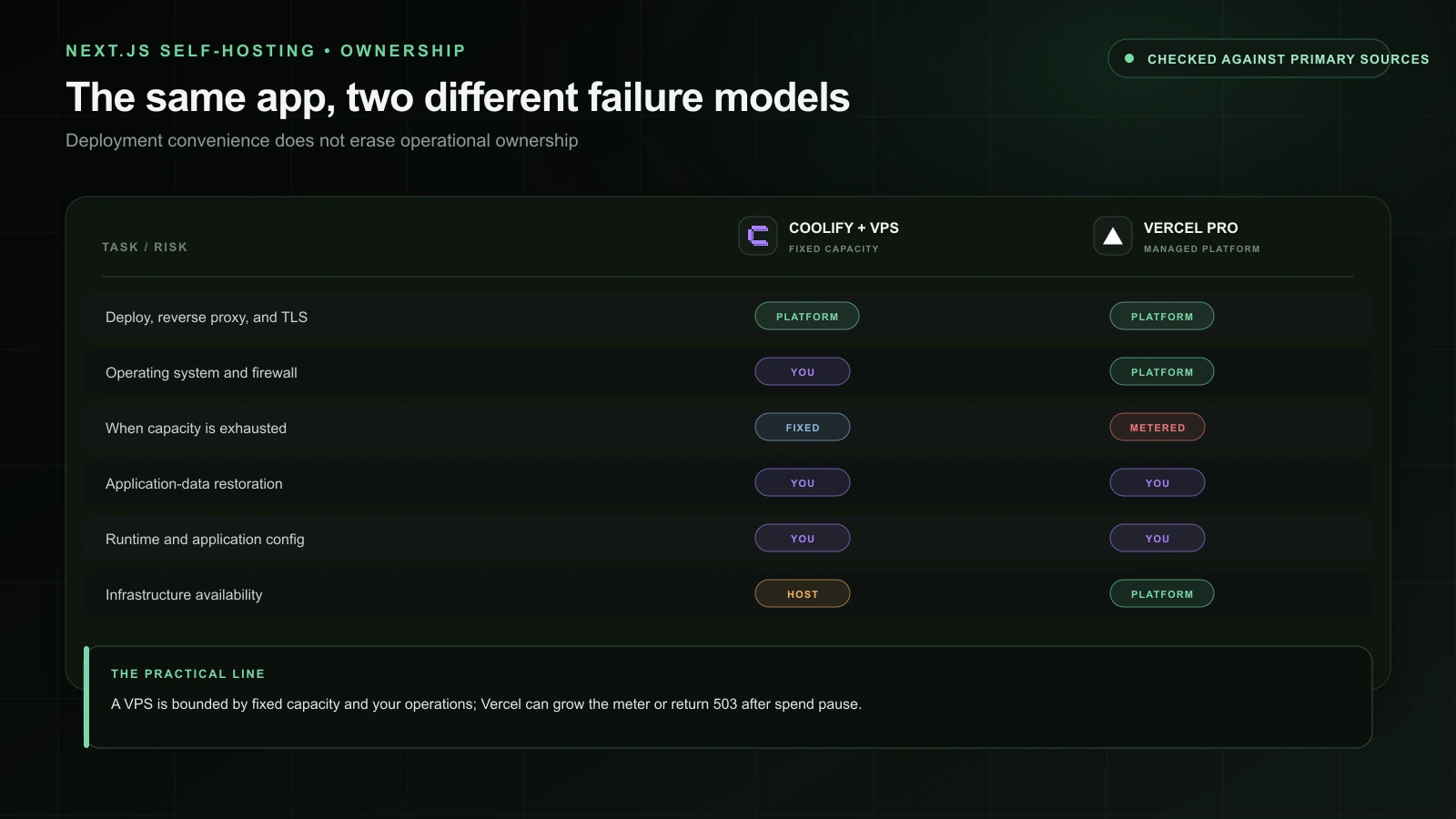
Neither option removes work. Vercel moves much of the infrastructure work into the platform and its pricing model. Coolify removes repetitive deployment work while leaving the machine, data, and capacity under your control.
Next.js does not require Vercel
The current Next.js deployment guide has a deliberately small minimum: a Node.js server. A single next start process can run Server Components, ISR, Cache Components, Server Actions, and the rest of the framework. A Docker container is also a standard deployment target.
“It runs” is not the same as “every environment behaves identically.” Once one instance becomes several, cache sharing and revalidation coordination matter. A buffering reverse proxy can erase the latency benefit of streaming. Deployments need compatible encryption and version identifiers. Vercel supplies an integrated answer to many of those details. In a self-hosted setup, they become part of your design.
Vercel is therefore not a license that unlocks Next.js. Its product is the managed build, delivery, security, observability, and scaling environment around the framework.
Three names, three different jobs
- A VPS is a virtual machine with a defined amount of CPU, memory, storage, and networking. You own the operating system and the services running on it.
- Coolify is not a hosting provider. It installs on your infrastructure and manages builds, containers, domains, reverse proxying, and TLS.
- Vercel builds and runs the application inside a managed platform. You buy a plan and metered resources instead of administering an individual host.
Coolify Self-Hosted being free does not make the deployment free. The server, storage, backups, network overage, and maintenance still exist. In the same way, Vercel’s plan price is not necessarily the final invoice.
Vercel has a free plan—with a commercial boundary
Vercel Hobby costs $0 per month. Leaving it out would make any price comparison misleading. The current Hobby documentation and Terms of Service, however, restrict that plan to personal, non-commercial use. Commercial deployments require Pro or Enterprise.
Pro is listed at $20 per month and includes $20 in usage credit. Usage beyond the included resources can be billed on demand, so $20 is a starting point rather than a ceiling. Additional team members may add a per-user charge.
Spend Management provides alerts and actions, not magic. Setting an amount alone does not stop usage; the production-pause action must be enabled. Vercel checks metered usage every few minutes. If the threshold triggers a pause, visitors receive 503 DEPLOYMENT_PAUSED, and projects must later be resumed individually. Seats, integrations, and separate add-ons can sit outside the spend amount.
That can be a useful emergency brake. It should not be mistaken for a reliability plan or an exact real-time cap.
Why a VPS bill looks simpler
A VPS begins with a rented capacity. As one current reference point, Hetzner lists the CX23 in Germany and Finland at €5.49 per month before VAT for new orders from June 15, 2026. A Primary IPv4 address adds €0.50, making the narrow server total €5.99 per month before VAT.
That number is not the total cost of running an application. It excludes a domain, off-server backups, extra storage, managed data services, email, traffic overage, and maintenance time. Coolify’s own installation guide recommends at least two CPU cores, 2 GB of memory, and 30 GB of free storage. Builds and the live process can compete for those resources on a small machine.
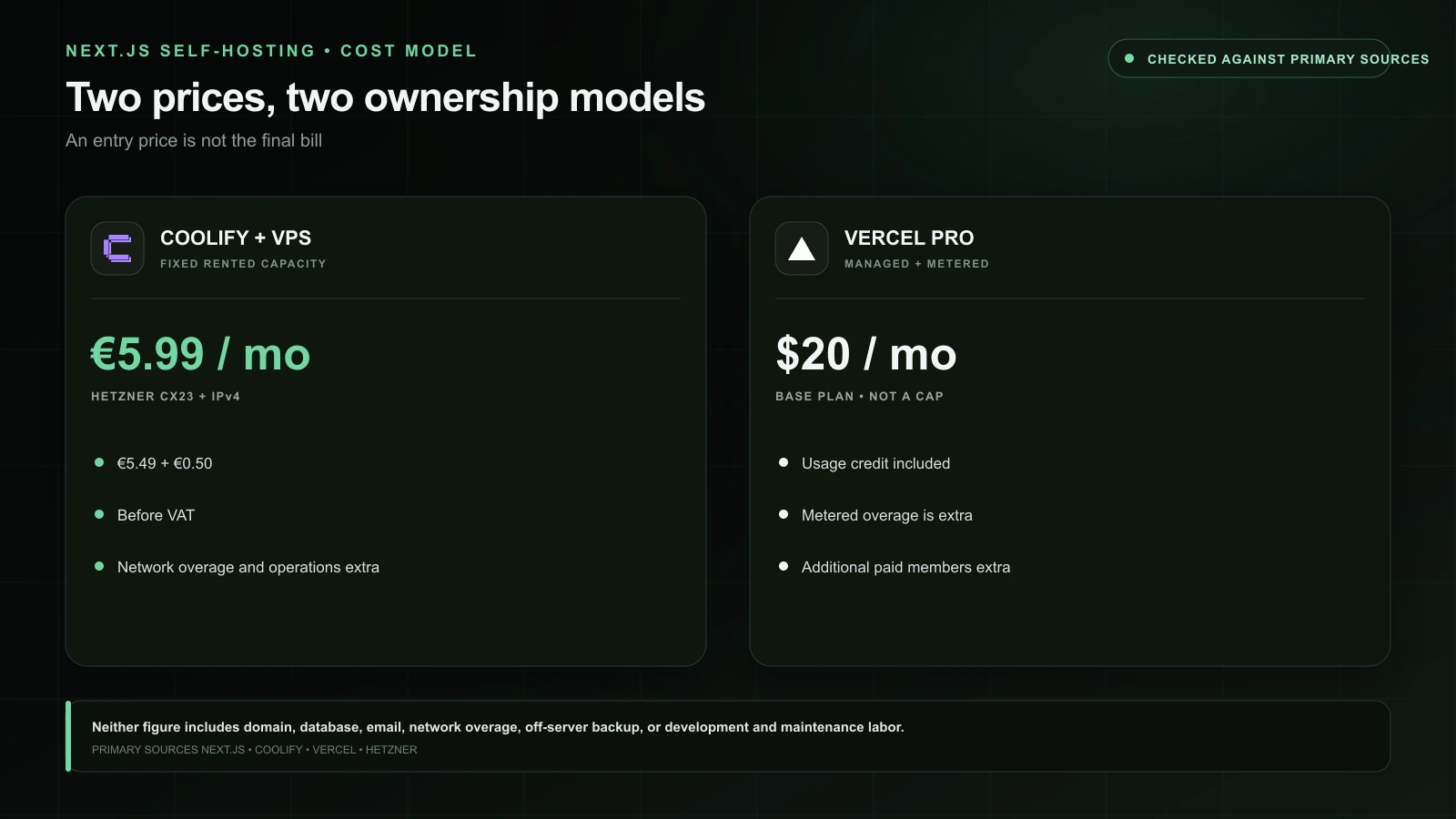
A fixed bill also does not imply elastic capacity. When the machine runs out of CPU or memory, the immediate result may be latency or an outage instead of a larger invoice. That is a different failure mode, not automatically a better one.
What Coolify removes—and what remains
Coolify puts Git-based deployments, Docker builds, environment variables, domains, reverse proxying, and TLS behind one interface. Replacing a collection of deployment scripts with a coherent control plane is useful.
It does not remove the work below:
- operating-system and Coolify updates,
- SSH access, firewall rules, and server hardening,
- disk, memory, and CPU monitoring,
- off-server backups of application data,
- a restoration procedure that has actually been tested,
- incident response when the server or provider fails.
Coolify’s backup documentation draws an especially important line: a backup of the Coolify instance does not include application data or mounted volumes. Backing up the control panel is not the same as backing up the system it deploys.
When Vercel earns its premium
Vercel offers more than a convenient Git integration. It combines preview deployments, a Next.js-aware delivery path, platform security controls, usage visibility, and managed host operations.
That model is easier to justify when:
- you do not want to operate an internet-facing server,
- preview and production workflows remove work you actually have,
- you will monitor usage meters and budget alerts,
- you accept the platform’s runtime and pricing boundaries.
Coolify on a VPS becomes more attractive when fixed capacity, Docker-based portability, and direct operational control matter more. It should only be called cheaper after backups, monitoring, and maintenance are included in the comparison.
Five questions that make the decision clearer
- Who will operate the server? If the honest answer is “not me,” the VPS sticker price is incomplete.
- Where should the hard boundary appear? Metered platforms can grow the bill; fixed servers can exhaust capacity.
- Will one instance be enough? Multi-instance Next.js introduces cache and revalidation coordination that a single process does not need.
- How will data return after a failure? A deployment tool is not an application-data disaster-recovery plan.
- Can the application leave? A reproducible container, environment inventory, and tested restore path make provider changes less painful.
There is no default winner
Vercel converts a large part of host ownership into a managed, metered service. Coolify organizes deployment on infrastructure you still own and operate. Both are coherent choices; neither is free of consequences.
Do not decide by placing €5.99 next to $20. List the resources the application actually uses, the operations you are genuinely willing to perform, and the failure you would rather handle. The better option is the one whose cost and responsibility remain understandable after the first successful deploy.
Primary sources
- Next.js — platform deployment and minimum requirements
- Next.js — self-hosting, reverse proxies, streaming, and multi-instance caching
- Coolify — installation and server requirements
- Coolify — Cloud and Self-Hosted ownership
- Coolify — instance backups versus application data
- Vercel — Hobby and Pro pricing
- Vercel — Hobby plan limits
- Vercel — Spend Management and production pausing
- Hetzner — Cloud prices effective June 15, 2026
- Hetzner — Primary IP and Cloud server pricing model
Prices and plan conditions were checked against official sources on July 28, 2026. Providers can change them; verify the current pages before purchasing.
About the Author

Enes Kaymaz
Enes Kaymaz
Designs, writes code, and occasionally turns the two into a product.
Read More About Me →Related Posts
View All →
Framer vs Next.js: A 2026 Guide for Portfolios, SaaS, Ecommerce, and Landing Pages
What Framer and Next.js actually do, where each one fits, and when a portfolio, application, store, or landing page needs a different answer.
Read More →
Is TypeScript 7 Really 10x Faster? A Real Next.js 16 Migration
A real Next.js 16 project cut median standalone type-checking from 4.79s to 0.45s, but the direct TypeScript 7 upgrade broke compiler-API consumers. Here are the benchmark, working setup, and migration limits.
Read More →Subscribe to my newsletter
Get the latest updates on design, development, and tech trends.