Do Claude Code and Copilot CLI Actually Make Developers Faster? Microsoft’s 2026 Data
Claude Code and GitHub Copilot CLI are command-line coding agents. Instead of only suggesting the next line, they can inspect a repository, change several files, and run commands such as tests. That broader reach makes “does it write code faster?” an incomplete question. Someone still has to understand the change, review it, merge it, and deliver it to users.
A Microsoft study covering tens of thousands of engineers estimates that users of these tools merged roughly 24% more pull requests per engineer per day. A pull request is the review record for a proposed code change; merging it means the change was accepted into the shared codebase.
The result is meaningful, but it does not show that every developer became 24% faster. It identifies an increase at one company, over four months, at one stage of the delivery chain. This article follows that number back to the study design, compares it with conflicting research, and asks when additional PR output becomes additional product value.
What the Microsoft study actually measured
The July 2026 paper, “Adoption and Impact of Command-Line AI Coding Agents”, is an arXiv preprint by three Microsoft researchers, not a peer-reviewed final publication. Its adoption analysis covers Copilot CLI only because that rollout had a clearly defined eligible population. Its outcomes analysis includes engineers who used Copilot CLI, Claude Code, or both.
The main window runs from January 5 to April 29, 2026. A pull request counts as merged if it was completed within 28 days of creation. The researchers restrict the cohort to active engineers and use pre-rollout data to model what might have happened without the rollout. This is a large workplace field study, not a randomized experiment.
The headline result: 24% more merged PRs
The Bayesian synthetic-control model estimates a 24.0% increase in merged PRs per engineer per day, with a 95% credible interval from 14.5% to 33.7%. The lift remains visible throughout the four-month window, with no statistically distinguishable fade during that period.
A within-person analysis also rises with usage intensity: 15.0% more merged PRs in weeks with three tool-use days and 50.1% more in weeks with five or more, relative to that engineer’s zero-use weeks. This dose-response is not automatically causal. Heavy-use weeks may contain smaller or more agent-friendly tasks, and developers may reach for an agent precisely when work is easy to delegate.
Copilot CLI versus Claude Code
Among single-tool users, Claude Code weeks were associated with an 11.4% PR lift and Copilot CLI weeks with a 24.9% lift. That does not mean Copilot CLI is twice as good. The tools were not randomly assigned to identical tasks; Microsoft owns GitHub, and its internal systems may fit Copilot CLI unusually well. This is an observation about one working environment, not a universal product benchmark.
Trying a tool is not the same as benefiting from it
Copilot CLI adoption spread strongly through social exposure: engineers were more likely to try it when managers, close peers, or frequent reviewers had already used it. Sustained use followed a different pattern; engineers already producing pull requests regularly were more likely to keep using the CLI. These findings do not prove productivity. They show why distributing licenses alone is not the same as changing a workflow.
Why other studies reach different conclusions
They are not measuring the same thing. Tool capability, task boundaries, codebase familiarity, and whether the outcome is code, commits, pull requests, or releases all change the result.
A controlled task found 55.8% faster completion
A 2023 GitHub Copilot experiment asked participants to implement a JavaScript HTTP server. The Copilot group completed that bounded task 55.8% faster. Random assignment strengthens the causal claim for that task, but a standalone server exercise is not the same as changing a mature system with legacy constraints, review queues, and production risk.
Experienced maintainers were 19% slower in early 2025
METR’s randomized trial followed 16 experienced open-source developers through 246 real tasks in repositories they had known for years. With early-2025 tools available, completion time increased by 19%. Developers had expected a 24% speedup and still believed afterward that AI had made them 20% faster. When experts hold tacit project knowledge the model lacks, prompting, waiting, and reviewing can erase the time saved by generation.
Velocity and complexity can rise together
The peer-reviewed MSR 2026 study “AI IDEs or Autonomous Agents?” found average increases of 36.25% in commits and 76.59% in lines added in open-source repositories where an agent was the first observable AI tool. Static-analysis warnings also rose by roughly 18–19%, while cognitive complexity increased by about 35–43%. These are maintainability signals rather than direct production-defect counts, but they show why more code cannot stand in for a better system.
Writing code is not the same as shipping software
The May 2026 NBER working paper “Writing Code vs. Shipping Code” combines AI-use telemetry with data from more than 100,000 GitHub developers. The authors estimate cumulative commit effects of roughly 40% for autocomplete, 140% after adding interactive agents, and 180% after adding autonomous agents.
But the 180% effect on commits attenuates to about 50% for projects touched and 30% for releases. Across four app marketplaces, new apps increase moderately while total usage does not. This is an observational working paper, so its percentages are not universal constants. The important finding is how the effect shrinks further down the delivery chain:
code generated
  → commits created
  → pull requests reviewed
  → releases shipped
  → value reaches users
AI can expand the supply of code faster than people can review, coordinate, test, and release it. If review capacity does not grow, the bottleneck moves rather than disappears.
What the evidence says together
| Study | Strongest evidence | Main limitation |
|---|---|---|
| GitHub Copilot experiment, 2023 | Causal speedup on one bounded task | Limited resemblance to long-lived production work |
| METR RCT, 2025 | Real tasks in familiar repositories | 16 developers and early-2025 tools |
| Microsoft preprint, 2026 | Large-scale enterprise telemetry | Self-selection, one company, and PRs as proxy |
| MSR study, 2026 | Measures velocity and maintenance signals together | Observable adoption and repository-level confounding |
| NBER working paper, 2026 | Measures attenuation from code to release | Observational design and limited private-work visibility |
The combined result is straightforward: modern agents can increase code and pull-request output in some environments. The size of the gain depends on the task, the developer, and where measurement occurs. Quality and user value still need their own evidence.
Where VibeConsole fits
VibeConsole is a free, open-source macOS terminal IDE for people working with Claude Code and OpenAI Codex CLI. It brings projects, a file explorer, multiple terminals, Git status and diffs, usage tracking, saved prompts, and JavaScript plugins into one workspace. Its official site does not claim Copilot CLI support, so this article does not claim it either.
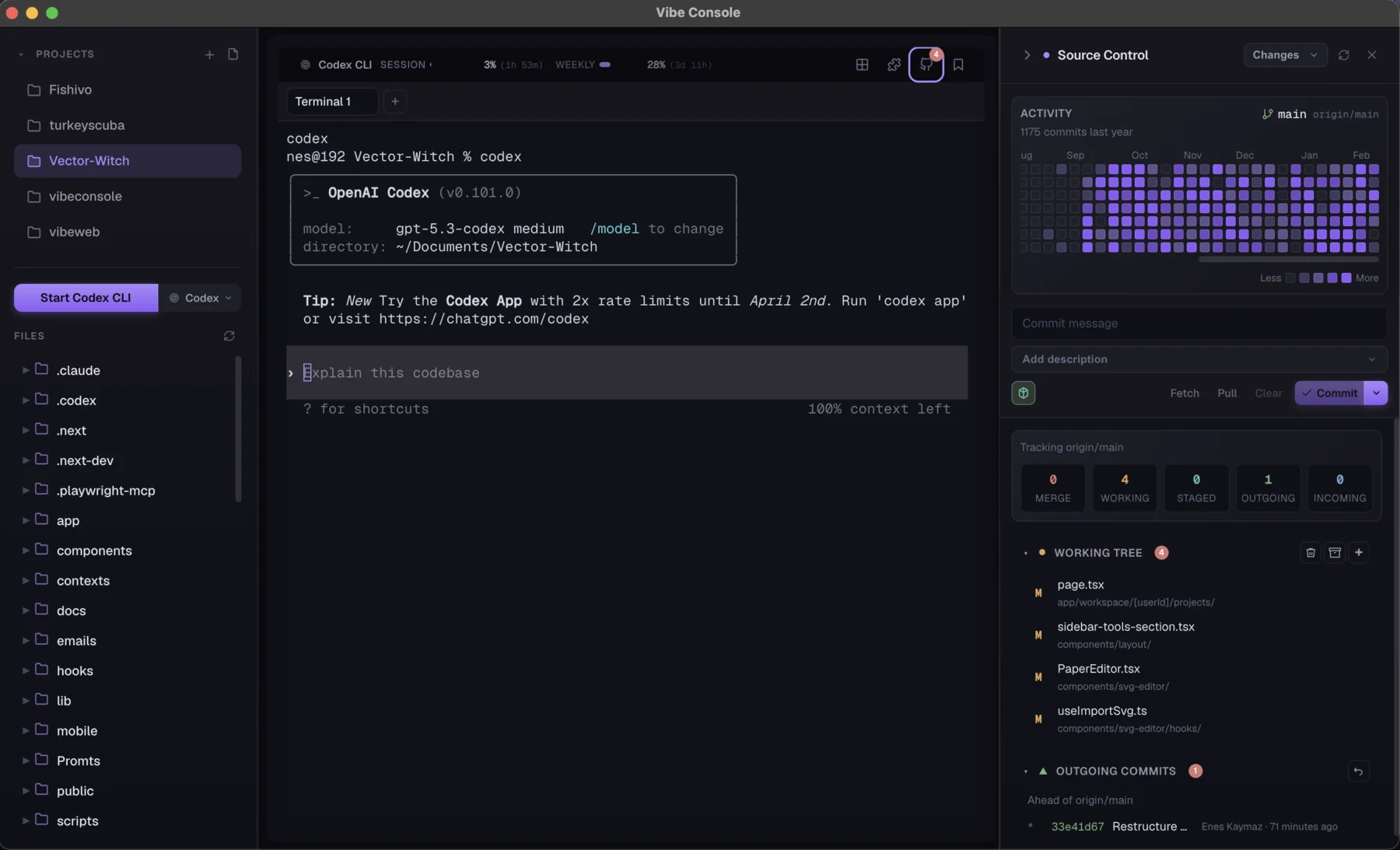
Once agents make work parallel, the problem is no longer just writing code: which session is active, what changed, what failed, and what is safe to merge? VibeConsole keeps terminals, project state, usage, and Git review visible in one place. That can make coordination easier. It is not evidence of a productivity gain; it is a clearer control surface for operating an agent workflow.
Disclosure: VibeConsole is one of my own projects. The Microsoft findings are not presented as a VibeConsole performance claim.
How to measure a real speedup
Pull-request or commit count alone is not enough. Track lead time, review wait, and deployment frequency alongside reverts, escaped defects, flaky tests, security findings, and complexity. Human time spent prompting, waiting, reviewing, and reworking belongs beside license, token, CI, and compute cost. At the final layer, measure whether the software is used, whether support load changes, and whether the product’s actual outcome metric moves.
Google’s Agent Quality Flywheel offers a practical loop: prepare evaluation data, run the agent, grade results independently, analyze failures, and compare every change with a baseline. The same principle works for individual developers: choose bounded tasks, write the acceptance test before the prompt, keep diffs small, and measure whether generation savings return later as rework.
What the 24% result proves
The Microsoft study is strong evidence that 2026-era CLI agents can move a concrete enterprise output metric at scale. A 24% increase in merged pull requests over four months is meaningful, but the study is not randomized and does not measure quality, so it cannot serve as a universal speedup rate.
The study shows that merged-PR output changed inside one company during one period. It does not show an equal improvement in code quality, release speed, or user value. If pull-request volume rises while review time, reverts, and escaped defects rise with it, production may have increased without a matching productivity gain. Tools such as VibeConsole can expose the workflow; those downstream measures have to supply the verdict.
Primary sources and further reading
- Microsoft researchers: Adoption and Impact of Command-Line AI Coding Agents (arXiv preprint, July 2026)
- Peng et al.: The Impact of AI on Developer Productivity — GitHub Copilot controlled experiment
- METR: Early-2025 AI and experienced open-source developer productivity
- Agarwal, He, and Vasilescu: AI IDEs or Autonomous Agents? (MSR 2026)
- Demirer, Musolff, and Yang: Writing Code vs. Shipping Code (NBER Working Paper 35275)
- Google Developers: Driving the Agent Quality Flywheel
- VibeConsole official site and product documentation
Sources checked July 15, 2026. The Microsoft study is an arXiv preprint; the NBER paper is a working paper circulated for discussion. Findings are labeled according to their actual study design.
About the Author

Enes Kaymaz
Enes Kaymaz
Designs, writes code, and occasionally turns the two into a product.
Read More About Me →Related Posts
View All →
TanStack Query Prefetching: Start the Request Before Navigation
Prefetching does not make an API faster; it starts likely future work earlier. This practical TanStack Query v5 guide covers query keys, freshness, request waterfalls, router and SSR choices, and how to measure the tradeoff.
Read More →
Where Should a Next.js App Run? Vercel vs Coolify on a VPS
A source-checked comparison of Vercel and Coolify on a VPS: what each one manages, what it costs, and which risks remain yours.
Read More →Subscribe to my newsletter
Get the latest updates on design, development, and tech trends.